# ants
 A goroutine pool for Go


[中文](README_ZH.md) | [Project Blog](https://taohuawu.club/high-performance-implementation-of-goroutine-pool)
Library `ants` implements a goroutine pool with fixed capacity, managing and recycling a massive number of goroutines, allowing developers to limit the number of goroutines in your concurrent programs.
## Features:
- Automatically managing and recycling a massive number of goroutines.
- Periodically purging overdue goroutines.
- Friendly interfaces: submitting tasks, getting the number of running goroutines, tuning capacity of pool dynamically, closing pool.
- Handle panic gracefully to prevent programs from crash.
- Efficient in memory usage and it even achieves higher performance than unlimited goroutines in golang.
## Tested in the following Golang versions:
- 1.8.x
- 1.9.x
- 1.10.x
- 1.11.x
- 1.12.x
## How to install
``` sh
go get -u github.com/panjf2000/ants
```
## How to use
Just take a imagination that your program starts a massive number of goroutines, from which a vast amount of memory will be consumed. To mitigate that kind of situation, all you need to do is to import `ants` package and submit all your tasks to a default pool with fixed capacity, activated when package `ants` is imported:
``` go
package main
import (
"fmt"
"sync"
"sync/atomic"
"time"
"github.com/panjf2000/ants"
)
var sum int32
func myFunc(i interface{}) {
n := i.(int32)
atomic.AddInt32(&sum, n)
fmt.Printf("run with %d\n", n)
}
func demoFunc() {
time.Sleep(10 * time.Millisecond)
fmt.Println("Hello World!")
}
func main() {
defer ants.Release()
runTimes := 1000
// Use the common pool.
var wg sync.WaitGroup
syncCalculateSum := func() {
demoFunc()
wg.Done()
}
for i := 0; i < runTimes; i++ {
wg.Add(1)
_ = ants.Submit(syncCalculateSum)
}
wg.Wait()
fmt.Printf("running goroutines: %d\n", ants.Running())
fmt.Printf("finish all tasks.\n")
// Use the pool with a function,
// set 10 to the capacity of goroutine pool and 1 second for expired duration.
p, _ := ants.NewPoolWithFunc(10, func(i interface{}) {
myFunc(i)
wg.Done()
})
defer p.Release()
// Submit tasks one by one.
for i := 0; i < runTimes; i++ {
wg.Add(1)
_ = p.Invoke(int32(i))
}
wg.Wait()
fmt.Printf("running goroutines: %d\n", p.Running())
fmt.Printf("finish all tasks, result is %d\n", sum)
}
```
## Integrate with http server
```go
package main
import (
"io/ioutil"
"net/http"
"github.com/panjf2000/ants"
)
type Request struct {
Param []byte
Result chan []byte
}
func main() {
pool, _ := ants.NewPoolWithFunc(100000, func(payload interface{}) {
request, ok := payload.(*Request)
if !ok {
return
}
reverseParam := func(s []byte) []byte {
for i, j := 0, len(s)-1; i < j; i, j = i+1, j-1 {
s[i], s[j] = s[j], s[i]
}
return s
}(request.Param)
request.Result <- reverseParam
})
defer pool.Release()
http.HandleFunc("/reverse", func(w http.ResponseWriter, r *http.Request) {
param, err := ioutil.ReadAll(r.Body)
if err != nil {
http.Error(w, "request error", http.StatusInternalServerError)
}
defer r.Body.Close()
request := &Request{Param: param, Result: make(chan []byte)}
// Throttle the requests traffic with ants pool. This process is asynchronous and
// you can receive a result from the channel defined outside.
if err := pool.Invoke(request); err != nil {
http.Error(w, "throttle limit error", http.StatusInternalServerError)
}
w.Write(<-request.Result)
})
http.ListenAndServe(":8080", nil)
}
```
## Functional options for ants pool
```go
type Options struct {
// ExpiryDuration set the expired time (second) of every worker.
ExpiryDuration time.Duration
// PreAlloc indicate whether to make memory pre-allocation when initializing Pool.
PreAlloc bool
// Max number of goroutine blocking on pool.Submit.
// 0 (default value) means no such limit.
MaxBlockingTasks int
// When Nonblocking is true, Pool.Submit will never be blocked.
// ErrPoolOverload will be returned when Pool.Submit cannot be done at once.
// When Nonblocking is true, MaxBlockingTasks is inoperative.
Nonblocking bool
// PanicHandler is used to handle panics from each worker goroutine.
// if nil, panics will be thrown out again from worker goroutines.
PanicHandler func(interface{})
}
func WithOptions(options Options) Option {
return func(opts *Options) {
*opts = options
}
}
func WithExpiryDuration(expiryDuration time.Duration) Option {
return func(opts *Options) {
opts.ExpiryDuration = expiryDuration
}
}
func WithPreAlloc(preAlloc bool) Option {
return func(opts *Options) {
opts.PreAlloc = preAlloc
}
}
func WithMaxBlockingTasks(maxBlockingTasks int) Option {
return func(opts *Options) {
opts.MaxBlockingTasks = maxBlockingTasks
}
}
func WithNonblocking(nonblocking bool) Option {
return func(opts *Options) {
opts.Nonblocking = nonblocking
}
}
func WithPanicHandler(panicHandler func(interface{})) Option {
return func(opts *Options) {
opts.PanicHandler = panicHandler
}
}
```
`ants.Options`contains all optional configurations of ants pool, which allow you to customize the goroutine pool by invoking option functions to set up each configuration in `NewPool`/`NewPoolWithFunc`method.
## Customize limited pool
`ants` also supports customizing the capacity of pool. You can invoke the `NewPool` method to instantiate a pool with a given capacity, as following:
``` go
// Set 10000 the size of goroutine pool
p, _ := ants.NewPool(10000)
```
## Submit tasks
Tasks can be submitted by calling `ants.Submit(func())`
```go
ants.Submit(func(){})
```
## Tune pool capacity in runtime
You can tune the capacity of `ants` pool in runtime with `Tune(int)`:
``` go
pool.Tune(1000) // Tune its capacity to 1000
pool.Tune(100000) // Tune its capacity to 100000
```
Don't worry about the synchronous problems in this case, the method here is thread-safe (or should be called goroutine-safe).
## Pre-malloc goroutine queue in pool
`ants` allows you to pre-allocate memory of goroutine queue in pool, which may get a performance enhancement under some special certain circumstances such as the scenario that requires an pool with ultra-large capacity, meanwhile each task in goroutine lasts for a long time, in this case, pre-mallocing will reduce a lot of costs when re-slicing goroutine queue.
```go
// ants will pre-malloc the whole capacity of pool when you invoke this method
p, _ := ants.NewPool(100000, ants.WithPreAlloc(true))
```
## Release Pool
```go
pool.Release()
```
## About sequence
All tasks submitted to `ants` pool will not be guaranteed to be addressed in order, because those tasks scatter among a series of concurrent workers, thus those tasks would be executed concurrently.
## Benchmarks
```
OS: macOS High Sierra
Processor: 2.7 GHz Intel Core i5
Memory: 8 GB 1867 MHz DDR3
Go Version: 1.9
```
In that benchmark-picture, the first and second benchmarks performed test cases with 1M tasks and the rest of benchmarks performed test cases with 10M tasks, both in unlimited goroutines and `ants` pool, and the capacity of this `ants` goroutine-pool was limited to 50K.
- BenchmarkGoroutine-4 represents the benchmarks with unlimited goroutines in golang.
- BenchmarkPoolGroutine-4 represents the benchmarks with a `ants` pool.
The test data above is a basic benchmark and more detailed benchmarks are about to be uploaded later.
### Benchmarks with Pool
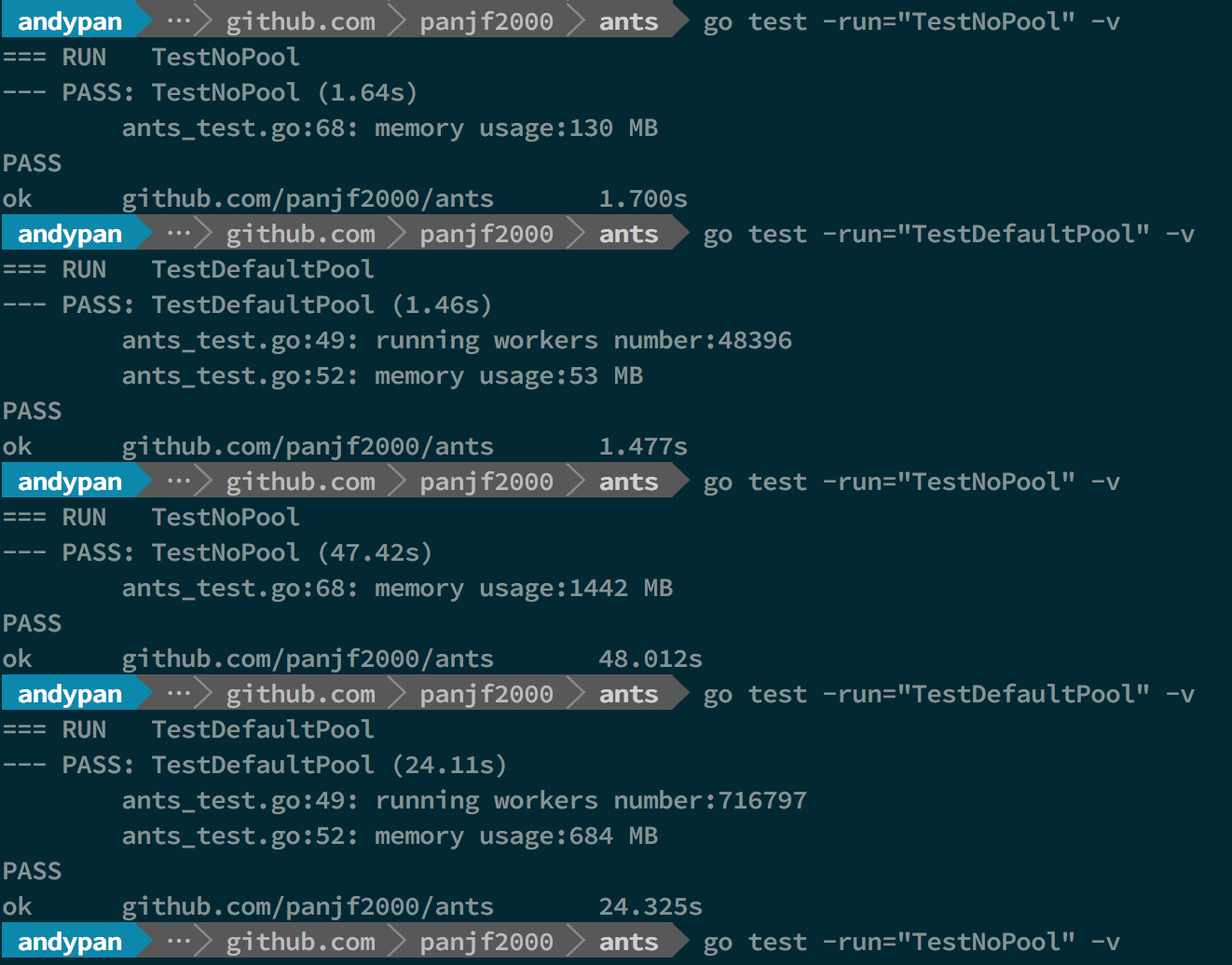
In above benchmark picture, the first and second benchmarks performed test cases with 1M tasks and the rest of benchmarks performed test cases with 10M tasks, both in unlimited goroutines and `ants` pool, and the capacity of this `ants` goroutine-pool was limited to 50K.
**As you can see, `ants` can up to 2x faster than goroutines without pool (10M tasks) and it only consumes half the memory comparing with goroutines without pool. (both 1M and 10M tasks)**
### Benchmarks with PoolWithFunc
### Throughput (it is suitable for scenarios where asynchronous tasks are submitted despite of the final results)
#### 100K tasks
#### 1M tasks
#### 10M tasks

### Performance Summary
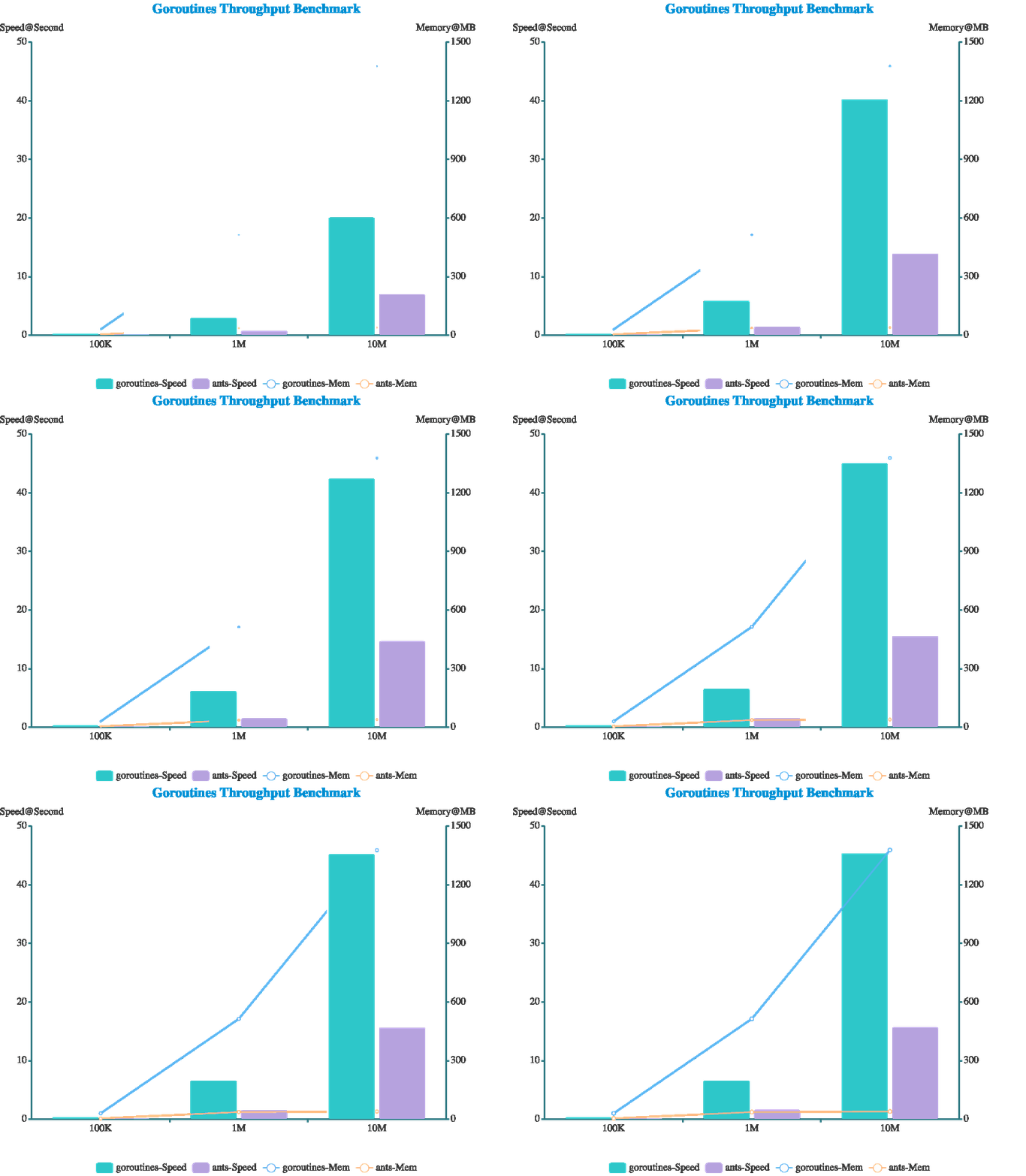
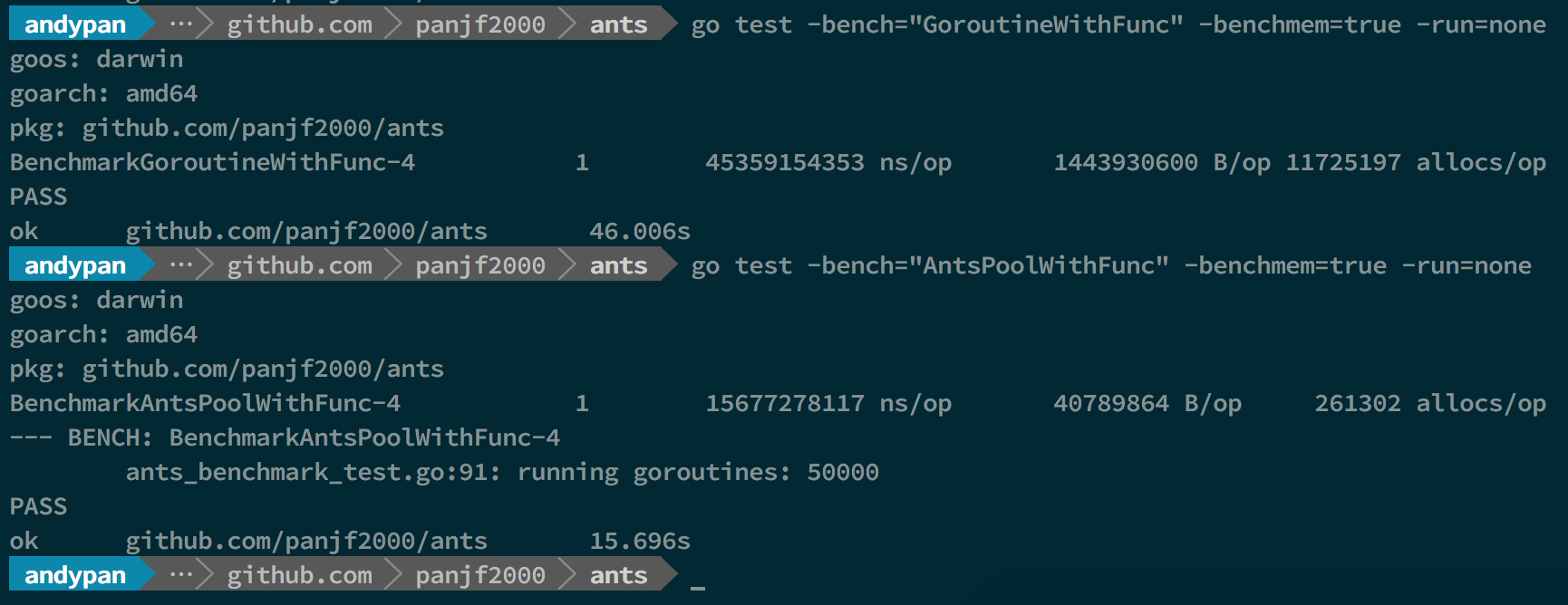
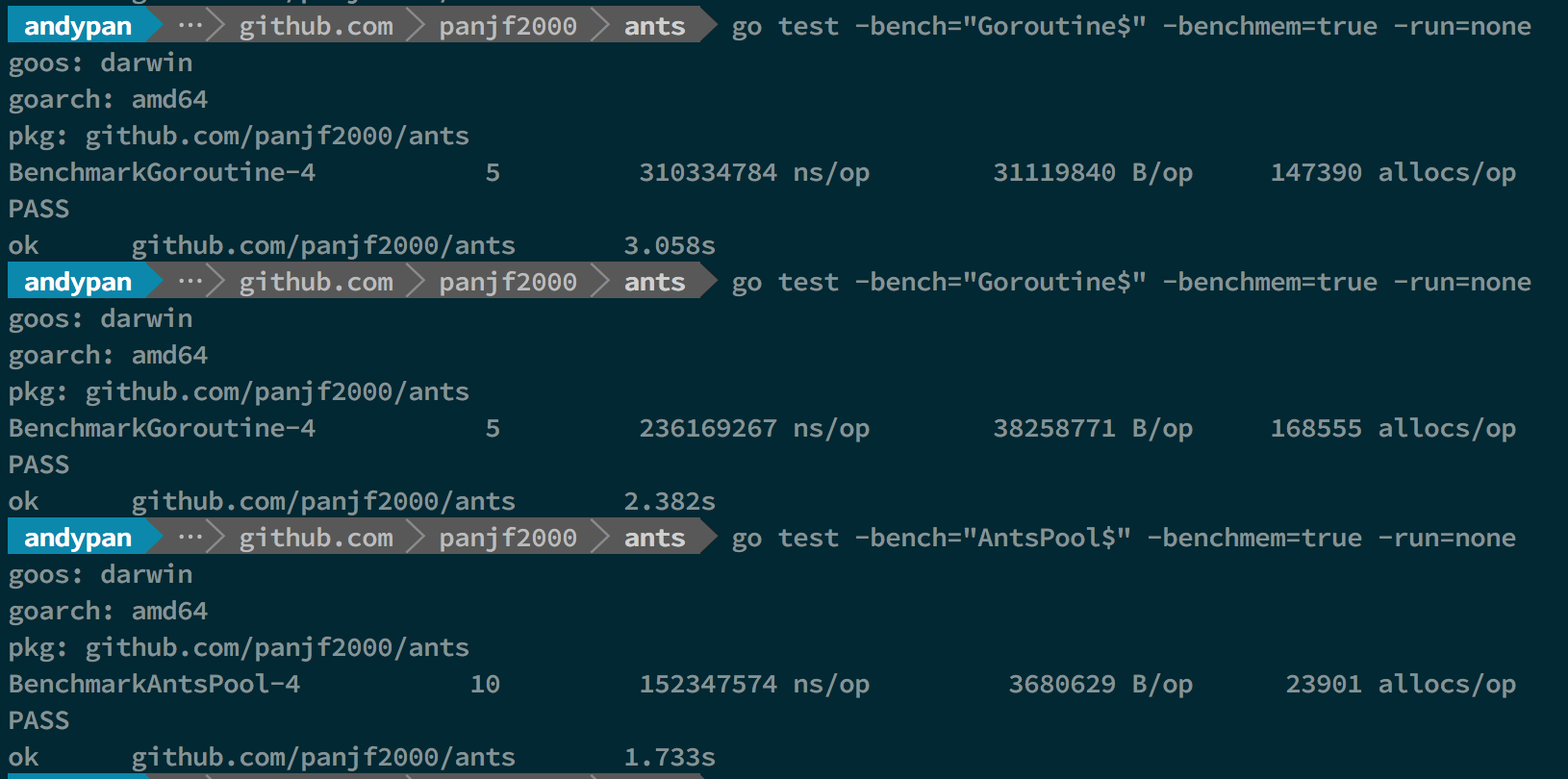
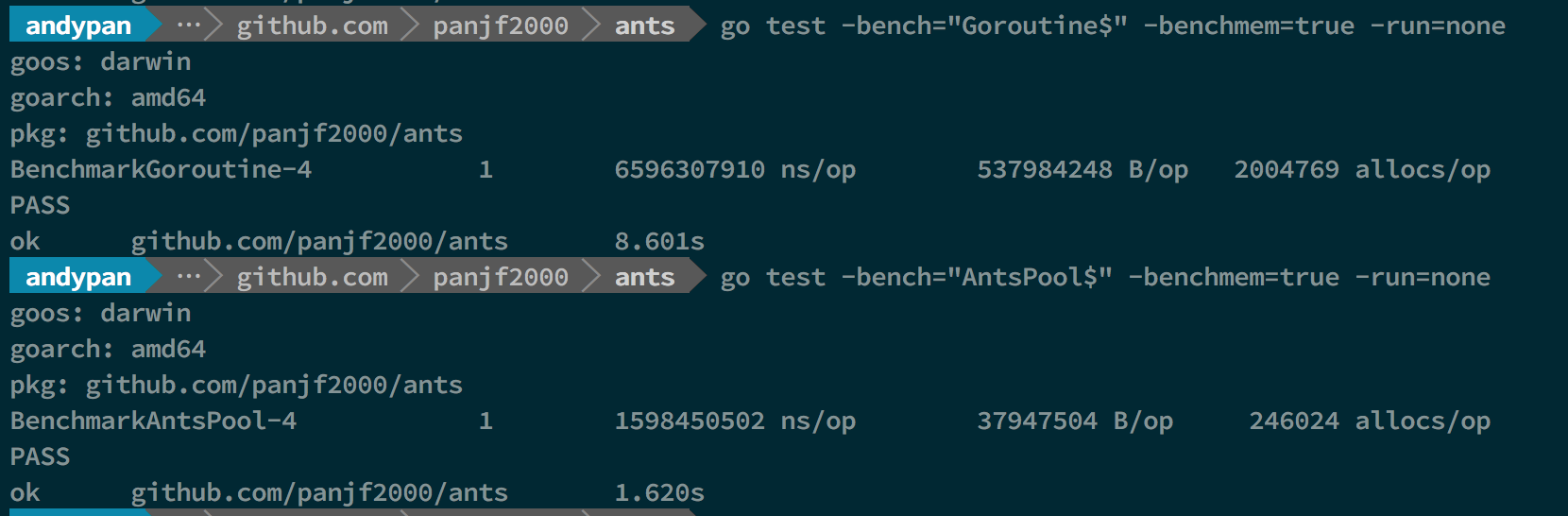
**In conclusion, `ants` can up to 2x~6x faster than goroutines without a pool and the memory consumption is reduced by 10 to 20 times.**
